
Fields in Scott County Property Tax Records
Tax research starts with the PVA roll. Then it moves to the office that collects. The PVA assesses real property at fair cash value under KRS 132.690, tracks deeds for assessment use, maintains parcel and building data, and administers exemptions. It sets no tax rates. The Sheriff handles collection, gathering state, county, school, city, and special-district charges across the county's tax districts.
| Field | What It Shows | Where |
|---|---|---|
| Land value | Assessment assigned to the land | Scott County PVA parcel record |
| Improvement value | Assessment assigned to buildings and improvements | Scott County PVA parcel record |
| Total and taxable value | Roll total and the amount left after an allowed exemption | Scott County PVA parcel record |
| Bill and payment status | Charges, due status, penalties, and payment record | Scott County Sheriff tax lookup |
| Municipal account | Separate city levy when the parcel lies in city limits | Applicable city tax office |
A recent sale price is a transaction fact. It does not automatically become an assessment. The PVA may estimate fair cash value through comparable sales, replacement cost less depreciation plus land, or income for income-producing property. A distress transfer may not reflect fair cash value. Note the assessment year and whether the sale was qualified before comparing any figures.
Scott County PVA Values and Search Keys
The Scott County PVA is the address-first source for the parcel behind a bill. Searches run by address or street. Owner name and GIS Map ID work too. A map search rounds out the options. The live screen layout has shifted over time, so confirm the current labels when you visit the site.
| Search clue | Best use | Possible snag |
|---|---|---|
| Address or street | Find the physical parcel and situs | Old numbers, units, or spelling variants |
| GIS Map ID | Match the current mapped parcel | The key may change after a split or consolidation |
| Owner name | Find parcels tied to the assessment-roll name | Trust, LLC, estate, initials, or same-name results |
| Map search | Locate land when few text clues are known | Mapped lines remain general-reference data |
A parcel card can carry a lot of detail. Look for land, improvement, total, and taxable values, plus the sale date and price, property class, district, and acreage. Deed and plat references often appear too. Building traits round out the card.
Exact labels and refresh timing may vary, so treat the card as a snapshot of the PVA's working data rather than a certified figure. If the web card fails to load, call the PVA at 502-863-7885 or go through its office record route.
Three Methods Behind Scott County Assessments
The PVA describes three valuation methods. The sales-comparison method studies recent sales of similar property. The cost method weighs replacement cost, depreciation, and land. The income method examines income and expenses for stores, apartments, or factories. That is why one deed price need not become the next roll value.
Field representatives collect building permits. They inspect additions, garages, pools, manufactured homes, apartments, and business improvements. Each parcel gets an on-site exam every four years. Real property is revalued annually. A permit or inspection can change the improvement record. That can happen at a different time from a sale or deed update.
Note: Compare values only after matching the parcel and assessment year. Match the property class, improvement state, and the sale's qualification too.
Look Up a Scott County Tax Bill
The Scott County Sheriff tax-collection page posts the official links for current and prior bills. It also explains the office's collecting role. Start from a PVA parcel. Then open the Sheriff link. Record the year, bill or account key, district, amount, and payment status. Take each item as shown on the official screen. Payment details change often, so rely on that page directly.
- Find the parcel and current assessment through the PVA by address, GIS Map ID, or owner.
- Follow the Sheriff’s official current-year lookup and match the parcel or account details before reading the bill.
- Compare the bill year, districts, amount, due status, and payment entry with the PVA assessment year and taxable value.
- Check the prior-year route or the Clerk’s delinquent-tax certificate trail when an unpaid year matters.
- Assessed value
- The value placed on the property roll for the stated assessment year.
- Fair cash value
- The Kentucky standard for an estimated price in a fair voluntary sale.
- Taxable value
- The assessment remaining after a valid exemption is applied.
- Levy or rate
- The charge applied by a taxing district to the taxable assessment.
- Tax lien
- A recorded or statutory claim tied to unpaid tax, subject to later payment, assignment, release, or court action.
Georgetown Adds a City Tax Record
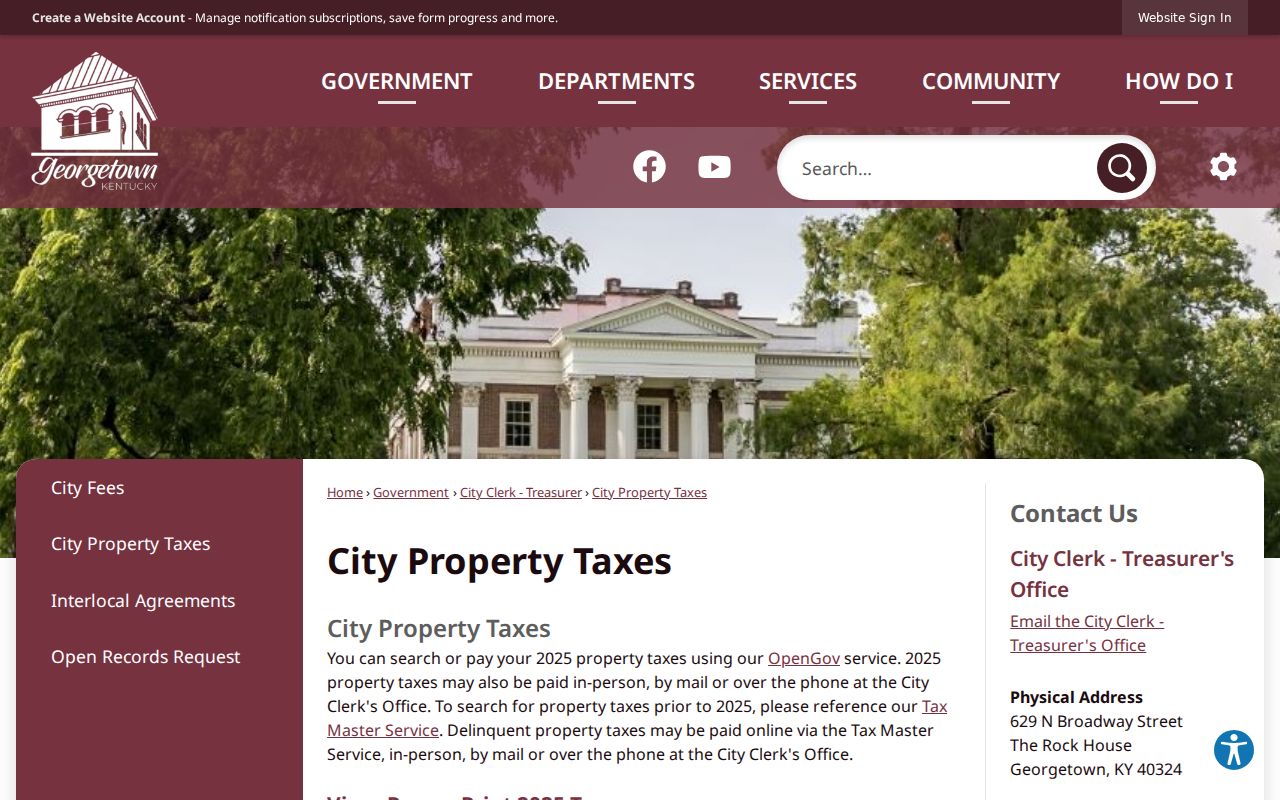
A Georgetown mailing address alone proves nothing about city tax. Confirm the parcel against the GSCPC city-limit layer. Inside the limits, the city property-tax page routes current years to OpenGov. Prior years go to Tax Master. Current searches accept PIDN, Map/Parcel, Location Address, Street Name, and Mailing Name. Tax Master guests log in as “Guest.” They search by bill number, name, address, account number, or map number.
The same page posts a delinquent list. It filters one tax year or all years. The list can display up to 3,000 entries and sort by account balance. That list is one part of the record. It does not replace the Sheriff bill, the PVA roll, or a Clerk certificate. Later court and deed research stands apart from it too.
The Georgetown tax instructions show both current and prior access.
The mapped city limit decides the question. If the parcel sits inside Georgetown, that separate city account belongs in the search.
Delinquent Scott County Tax Is a Trail
An unpaid tax entry is only a lead. It is not a completed foreclosure or a clean ownership result. Follow the annual bill forward. The County Clerk's delinquent-tax certificate is the next stop. Look for assignments, releases, later deed filings, or court proceedings. A certificate can pass to a third party under Kentucky's process, yet its existence alone proves neither physical possession nor marketable title.
Each layer answers a different question. A careful file should retain the tax year, parcel and account identifiers, certificate information, assignee if any, release or payoff entry, court case, sale and confirmation order, and any commissioner's deed. That layered check keeps one delinquent row from ending the property story.
Scott County’s Annual Assessment Calendar
Kentucky ties its whole property-tax year to a single date: January 1. That day sets the assessment. Real property is then listed through March 1. The Kentucky property-tax calendar opens public inspection on the first Monday in May. It runs thirteen days, six days a week. Saturdays are included. Afterward, a local board of assessment appeals convenes within twenty-five to thirty-five days.
Ownership matters here. The PVA FAQ assigns tax responsibility to whoever owned the parcel on January 1 of that year. A closing, a deed recording, the bill mailing, or a later assessment-roll update may each carry its own date. Keep them separate rather than collapsing everything into one "current owner" label.
Scott County pairs annual revaluation with a four-year physical examination cycle. PVA field staff pull permits from the building inspector. They may measure, list, and photograph additions, garages, pools, manufactured homes, apartments, and business improvements. If nobody answers the door, they can estimate from what they can see and leave a card behind. That is why a new structure often lands on the tax roll after a permit or field visit rather than on the deed date.
A parcel card can list age, stories, rooms, exterior, foundation, heating and air systems, living area, basement, and pool details. These fields feed mass appraisal. They are not a safety inspection, proof that work passed final review, or a report on present condition. When a value change hinges on an improvement, compare the assessment record against permit and inspection files.
A homestead or disability exemption can lower taxable value for a qualifying owner under current rules. Read the public flag as tax status only. It says nothing reliable about age, health, household make-up, or who actually lives there. The PVA's separate mailing-address form makes the same point from another angle. A tax-mail destination is never the same field as property situs.
Contest a Scott County Assessment
A taxpayer cannot jump straight to the local board. Kentucky requires a conference with the PVA or a deputy first. The annual notice sets the order of events. So does that conference. The public-inspection window and the filing deadline do too. Check the PVA's appeal process. Check the Kentucky Revenue calendar for the year at issue, since a general date summary can't replace the current notice.
Evidence carries the appeal. Recent comparable sales help. So does a qualified appraisal. Construction-cost records, income and expense records for income property, and listing history all help. Match the evidence to the same assessment date, property type, location, and condition. A nearby sale turns weak fast if it reflects distress. It also weakens with a different class, or major improvements.
Appeal window. Complete the PVA conference and file within the annual statutory period shown on the notice and current calendar. Do not rely on last year’s dates.
Homestead and disability exemptions can lower taxable value for a qualifying owner under current law. The public flag is a tax status, nothing more. It does not license guesses about age, health, household make-up, or occupancy. Send application questions to the PVA, and avoid republishing completed forms or sensitive proof.
Note: Date-stamp Scott County property tax records. Assessments, exemptions, payments, and delinquency status change on different schedules.